Table of Contents
Last updated on March 27th, 2026 at 01:32 am
If you’ve spent any time around diet culture, you’ve likely heard someone proudly proclaim:
“I don’t eat anything white.”
Let’s think about this for a second. How ridiculous does it actually to drop foods into the “no no box” simply based on their color. We’re talking about eliminating all of the great hero’s of our childhood!
Rice?
Bread?
Pasta?
Potatoes?
Sugar?
Flour?
Cauliflower (except no one actually bans cauliflower because diet culture gets confused here)?
Forget about it. Just eliminate that nostalgia (and not to mention the abundance of nutritional value in these foods) and hand over your your happiness to diet culture.
The “no white foods” rule shows up everywhere. According to diet cultures standards, you might as well just translate the word “refined” to “completely fucked” when it comes to nourishing your body.
but where did it actually come from, and is there any truth to it?
Let’s break it down.
The Real Origin: A 15-Minute Medical Visit and a Blanket Rule
In my experience, the “anything but white” rule usually comes from a well-intentioned but very rushed practitioner who has exactly 15 minutes to address someone’s diabetes, blood pressure, cholesterol, weight, AND every other concern the patient has.
So instead of nuanced nutrition education, patients hear:
“Just avoid white foods.” Boom. Easy. Fast.
And wildly oversimplified. Not to mention inaccurate.
Somewhere along the way, diet culture took this watered-down advice and turned the word “refined” into: “Refined = Completely ruined.”
And of course, diet culture’s unofficial motto: “Sugar? F*ck sugar.”
But here’s the truth…
Why the “No White Foods” Rule Makes No Sense
Even for people managing chronic conditions, this rule falls apart almost instantly. This starts with the very obvious fact that the nutrition composition of food has literally NOTHING to do with its nutritional content.
Because what even is a “white food”?
Are we talking about potatoes? Rice? Bread? Pasta? Yogurt? Milk? Bananas? Oats?
Those are wildly different foods with completely different nutrient profiles — the only thing they have in common is… color. And your body does not categorize food by color. It instantly realizes how stupid this logic is and just goes about digesting this “white food” without discrimination. Imagine that!
Thousands of years of the body evolving to not give a flying fuck about the color of your food!
Let’s break down why this myth makes no sense any way you want to look at it.
1. It assumes fiber is the only nutrient worth caring about
The logic goes like this:
White foods = less fiber
Less fiber = “bad”
Therefore white foods = off limits
But fiber is one nutrient out of hundreds that support your body. Not to mention, every body is different with wildly different nutritional needs!
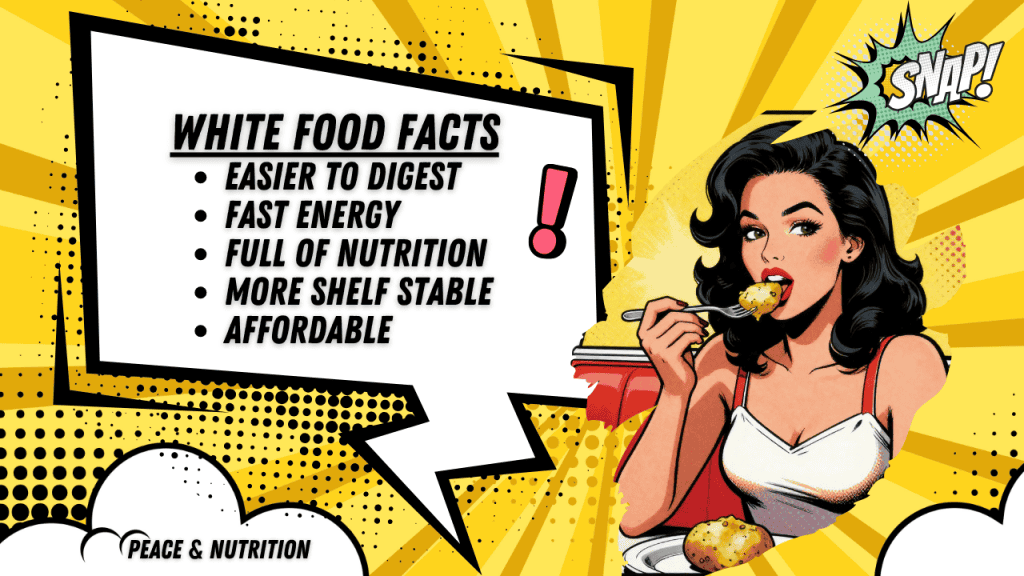
Lets take a look at white rice. White rice is often easier to digest, lower in fiber (which can actually be helpful in recovery or for sensitive digestion), and provides quick, accessible energy which is exactly what a healing body needs.
And bread?
Bread is literally a staple food across cultures for a reason. It’s accessible, versatile, and a consistent source of energy. It’s not mandatory for every food ever to have the most fiber possible for it to offer your body heaps of nutritional value.
And guess what?
- Not all white foods are low in fiber.
- Not all white foods are refined.
- Not all white foods are nutritionally “less than.”
Wild concept, I know.
2. It ignores that white foods contain valuable nutrients
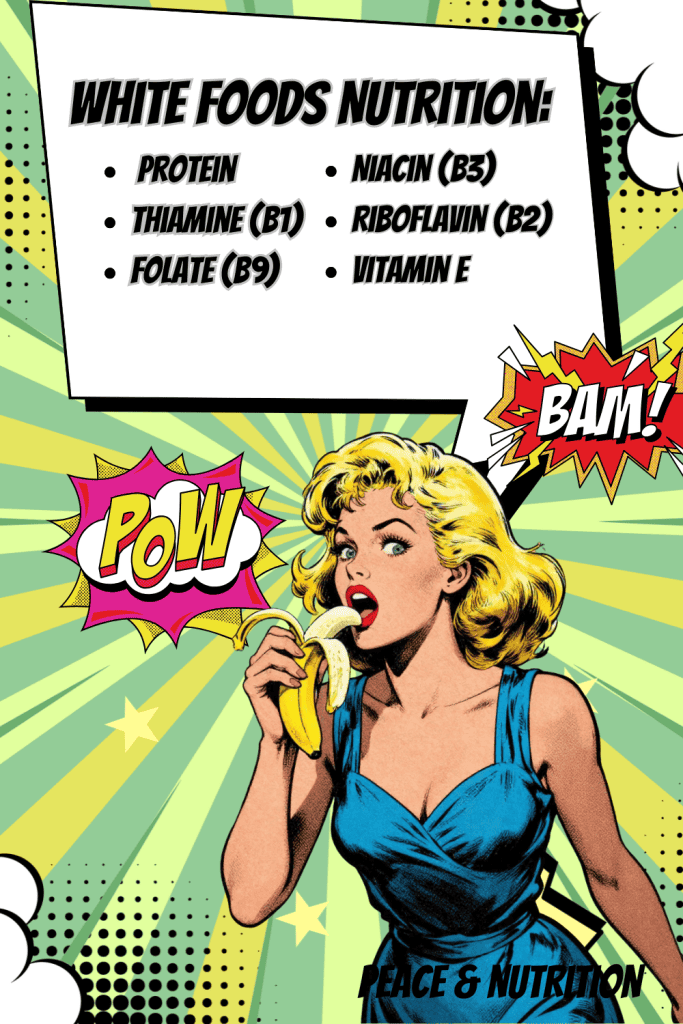
Many white-colored foods — even refined ones — can offer:
- Protein
- Thiamine (B1)
- Folate (B9)
- Niacin (B3)
- Riboflavin (B2)
- Vitamin E
Just to name a few.
Your body is looking for carbohydrates, fats, protein, vitamins, minerals, and energy — not whether something is beige enough to be feared.
Let’s take potatoes, since they get dragged the most.
Potatoes are a carbohydrate source, yes.
They also contain potassium, vitamin C, fiber (especially with the skin), and are one of the most satiating foods you can eat.
So calling them “bad” because they’re white makes about as much sense as calling blueberries “bad” because they’re blue.
It’s arbitrary.
So when we demonize these foods, we’re also demonizing the nutrients that come with them.
3. It restricts more than it helps
Food rules don’t create health, they create:
- Restriction
- Fear foods
- Food avoidance
- Food shame and guilt
- Disconnection from hunger cues
- Loss of food satisfaction
- Binge eating
- A chaotic relationship with eating
What’s actually happening with rules like “no white foods” is that hey give the illusion of control. They make eating feel safer by shrinking your food world into something predictable.But in reality, they disconnect you from your body’s needs and create unnecessary fear around completely normal foods. Healing your relationship with food isn’t about finding new rules that feel more “acceptable.”It’s about removing the rules altogether and rebuilding trust.
Whether you’re managing diabetes, high blood pressure, high cholesterol, or nothing at all…
Overly simplistic and restrictive rules don’t make eating easier or healthier.
The Problem With “Off Limits” Foods
Labeling an entire category of foods as “bad” strips away:
- Flexibility
- Pleasure
- Cultural foods
- Practical options
- Nutrient variety
- Mental wellbeing
You deserve a relationship with food that isn’t full of landmines.
Even in the context of chronic condition management, there is room for white rice, bread, potatoes, pasta and yes even sugar.
Because nutrition is not defined by one color or one component of a food.
So… Can White Foods Fit Into a Balanced Diet?
Absolutely.
Wholeheartedly.
Without question.
White foods can:
- Provide energy
- Offer important vitamins and minerals
- Support digestive tolerance
- Increase satisfaction and food freedom
- Help you build sustainable, non-restrictive eating patterns
Nutrition is about the big picture — not the color palette.
Stop Letting Diet Culture Erase Half the Grocery Store
The “no white foods” rule is nothing more than a shortcut born out of rushed appointments and amplified by diet culture’s obsession with restriction. There is no color of food that inherently makes it “good” or “bad.”There is only how that rule is impacting your relationship with eating.
And if a rule is making you more anxious, more rigid, more fearful, or more disconnected from your body?
It’s not helping you — no matter how “healthy” it sounds.
You don’t need to cut out entire food colors.
You don’t need arbitrary rules.
You don’t need to fear bread, rice, or potatoes.
What you do need is balanced, flexible, individualized guidance — not one-size-fits-none food bans.

- 100 Snack Ideas for Eating Disorder Recovery - April 18, 2026
- Diet Culture is Toxic - December 22, 2025
- I Don’t Eat Anything White - December 11, 2025