Table of Contents
Last updated on June 29th, 2026 at 09:16 pm
When was the moment you learned that some bodies were valued more than others? When we say that some bodies are seen as having more value than others, we’re talking about a social belief system—not a biological truth.
It means that society assigns worth, respect, safety, and opportunity to people based on how closely their bodies match dominant ideals. Those ideals are usually shaped by thinness, whiteness, able-bodiedness, youth, masculinity/femininity norms, and productivity.
Think back:
- Where were you?
- How old were you?
- What message was given to you—directly or indirectly?
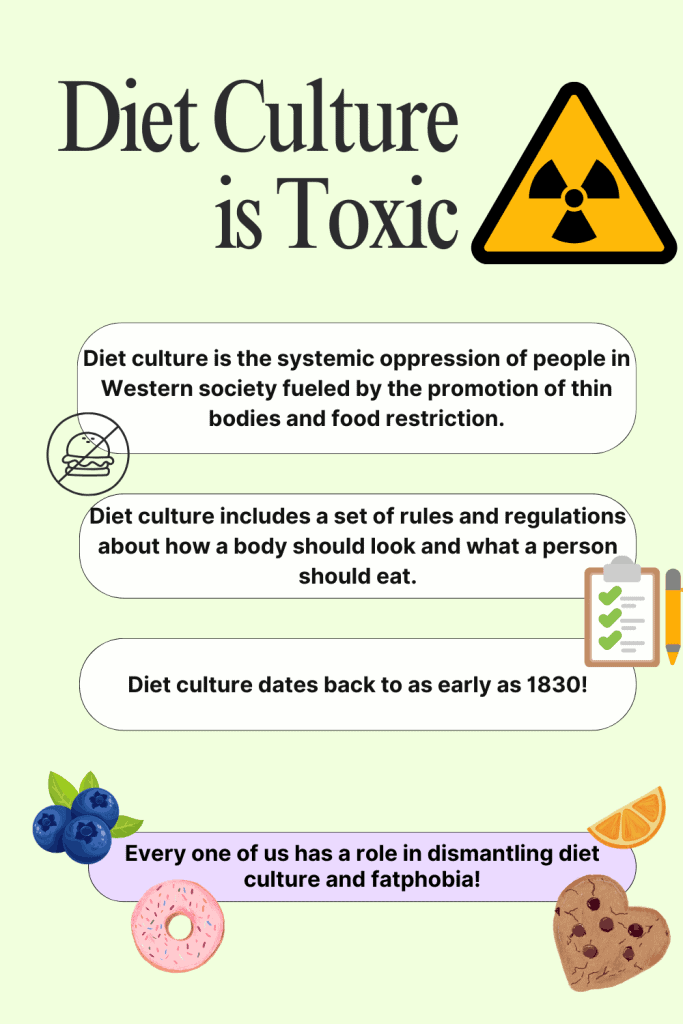
What if I told you that your thoughts about “good” or “bad” bodies don’t actually belong to you. That instead, these messages were involuntarily inherited from a history of diet culture that dates back to nearly a century ago.
Hang out tight- because we’re about to dig into some of the very racist and capitalist origins of why we feel the way we feel about which bodies hold the most value.
The Origin of Body Hierarchies
This idea of body hierarchy is rooted in:
- Diet culture (thin = good, fat = bad)
- Capitalism (productive bodies are more “valuable”)
- Racism, ableism, sexism, ageism, and colonialism
- Medical bias that confuses appearance with health
None of this is neutral or natural—it’s learned.
In Western culture, being “fat” is one of the most deeply feared identities, shaped by decades of weight stigma, media messaging, and harmful diet narratives.
Fatphobia in Action
Fatphobia is the fear, hatred, avoidance, or devaluation of fat bodies—both at an individual level and built into systems like healthcare, media, and workplaces.
Bodies that don’t fit those ideals are often:
- Policed, shamed, or pathologized
- Viewed as problems to be fixed
- Given lower-quality healthcare
- Excluded or stereotyped in media and culture
Bodies that fit the “ideal” are often:
- Treated with more respect and credibility
- Seen as healthier or more disciplined (even without evidence)
- Given better access to jobs, healthcare, dating, and safety
- Represented positively in media
I have heard too many times the harmful narrative “I don’t need to be super skinnny, I just don’t want to be the fattest person in the room.”
Reclaiming the Word “Fat”
What if we stopped using the word “fat” like it was the worst F word on out there? What if instead- we just used as a descriptive term. The same way we might use descriptors such as tall, blonde, or Asian?
In my practice, I intentionally use the word fat as a descriptive term—nothing more, nothing less.
No morality.
No hierarchy.
No superiority.
Now I challenge you:
How do you feel when you hear the word “fat”?
Is your reaction the same as when you hear words like freckled, brunette, tall, muscular, white, or Black?
If not, pause and consider:
Who created the standards you’re using to judge bodies—yours and everyone else’s?
Why are those standards allowed to dictate your worth?
Why This Rule (and Diet Culture) Fails You
Let’s break down what’s actually happening when you enter a room worried about being “the fattest person there.”
You’re assigning your self-worth based on other people’s bodies.
Your insecurities about someone taking up more or less physical space than you has nothing to do with them.
It has everything to do with your own experiences and fears.
So flip the lens:
What are you struggling with emotionally that makes their body feel threatening?
You already know diets fail—yet you still blame yourself.
At some point, everyone realizes:
- Diets fail.
- Diets suck.
- Diets don’t work.
- Biology is smarter than any “quick fix” you saw in a magazine.
And yet, when you’re around people steeped in diet culture, you internalize the failure.
You start telling yourself:
- “I’m undisciplined.”
- “I’m gluttonous.”
- “I’m lazy.”
- “I’m fat, so I’m unlovable.”
Diet culture then nudges you into comparing yourself to others as a way to feel “acceptable”:
- “If they’re more undisciplined, then I’m okay.”
- “At least I’m not as gluttonous as them.”
- “Their body is worse, so maybe I deserve love.”
- “People won’t notice my size if they notice theirs.”
AHHHH. Exactly.
Do you see it?
It Was Never About Them—It Was Always About You
Every judgment you thought you were making about them was actually a reflection of your own fear, shame, and internalized body rules.
One of the best pieces of advice I’ve ever heard:
“Nobody cares about you. They’re all too busy thinking about themselves.”
It’s true.
No matter the size of the person next to you, it will never determine how you feel inside.
Your Worth Has Never Been Measured in Pounds
Taking up space means allowing your body to be seen, heard, fed, rested, and accommodated without apology. It means your needs don’t have to be minimized to make others comfortable. Your presence is not a burden. Your body is not an inconvenience.
So many of us were taught—explicitly or subtly—that smaller is better. Quieter is safer. Less need is more acceptable. That shrinking ourselves is how we stay worthy, lovable, or in control. But shrinking doesn’t actually protect us. It just teaches us to disappear from our own lives.
So here’s your reminder:
- Show up in the room exactly as you are.
- Take up the space your body naturally takes up.
- Your worth is not tied to your size.
- Nobody is thinking about you more than you are.
You deserve to exist freely, fully, and without apology.

- I only shop the perimeter of the grocery store - June 30, 2026
- 100 Snack Ideas for Eating Disorder Recovery - April 18, 2026
- Diet Culture is Toxic - December 22, 2025